.svg)


Custom Website vs Template: How to Choose
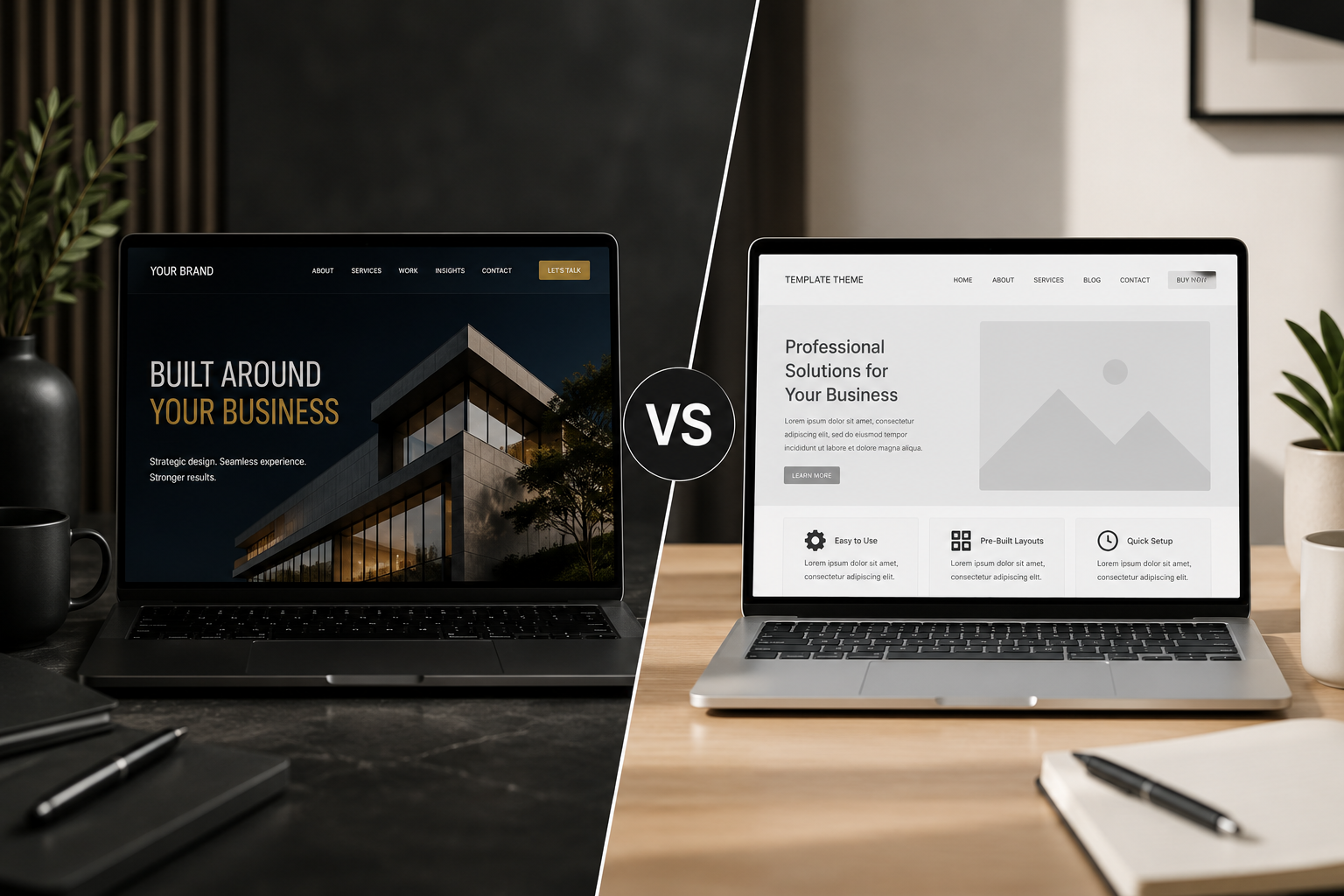
Templates win for budgets under $10,000, launch timelines under 30 days, and simple service sites where the goal is just to prove you exist. Custom wins for competitive B2B industries, businesses with complex functionality requirements, and companies planning to scale past template limits within 24 months. The 5 questions below tell you exactly which side of the line you sit on.
Most articles on this topic are written by agencies that make more money on custom builds, so they always conclude custom wins. That is not the honest answer. The real answer depends on 5 variables: your budget, your timeline, what your site actually needs to do, your growth stage, and how differentiated your brand needs to be.
This article covers what each option actually is (both terms get used loosely), when each one genuinely wins, hidden costs nobody mentions, and a framework for deciding. We build custom sites for a living. We also tell prospects when a template is the right call for where they are. This article is that same conversation, in writing.
What "template website" and "custom website" actually mean
Both terms get used loosely, which is why so many custom vs template debates end up talking past each other. Here is what they actually mean.
Template websites
A template website starts from a prebuilt design and structure that you customize with your own content, colors, and images. What you are buying is a design system somebody else made, with editing tools that constrain what you can change.
The template category includes Squarespace, Wix, Shopify themes, WordPress themes like Divi, Elementor, Astra, and GeneratePress, and Webflow templates.
Custom websites
A custom website is designed and built from scratch for your specific business. The design starts on a blank page. Layout, components, functionality, and technical architecture are all decisions made for you rather than inherited from a template.
The custom category includes bespoke Webflow builds, custom WordPress themes coded from scratch, custom React or Next.js builds, and any project where a designer and developer start from your brand and requirements rather than an existing theme. Choosing the right team for custom web design is what determines whether that blank page becomes a business asset or just another site that looks like everyone else's.
The gray middle
Most agency work sits between these two extremes. A "semi-custom" build starts from a template and gets heavily modified. A "design-system" build starts from a component library and produces a site that looks entirely custom. When you ask three agencies whether their work is custom or template, you will get three different answers because the line is fuzzy.
For the rest of this article, "template" means a build where the underlying design system is not made for you, and "custom" means a build where it is.
Template websites: what you get and what you give up
Where templates genuinely win
- Speed to launch. A template site can go live in 2 to 4 weeks. A custom build takes 8 to 16 weeks minimum. If you need to be online next month, template is your only realistic option.
- Cost. Templates run $2,000 to $10,000 all-in for the initial build. Custom builds start at $15,000 and go into six figures for complex projects.
- Predictability. With a template, you see the finished website design before you commit. No back-and-forth design review cycles. What you see in the demo is roughly what you get.
- Maintenance is handled. Hosted platforms like Squarespace and Wix take care of hosting, security patches, and updates automatically. For a business with no technical team, that is one less thing to worry about.
- Good enough for many use cases. A simple 5-page service site with a contact form does not need a custom build. A local plumber, a solo practitioner, an early-stage consultant. Templates are appropriate here and always will be.
Where templates fall short
- Constrained by the template's structure. You can change colors, fonts, and images. You cannot fundamentally change layout logic without breaking the template or paying a developer to hack around it.
- Common design DNA. Popular templates get used thousands of times across the same industry. Your site ends up looking like every other site in your space. In competitive markets where brand differentiation matters, that is a real problem.
- Performance ceilings. Template sites often ship with more code, plugins, and assets than any single site actually uses. Core Web Vitals suffer. Site speed matters for SEO, conversion, and user experience.
- Scalability limits. As your business grows, the template's constraints become your business's constraints. When you need something the template does not support, you either work around it (expensive and fragile) or rebuild.
- SEO ceilings. Some template platforms restrict URL structure, schema markup, and technical SEO controls in ways that cap organic growth. If ranking in a competitive market is a priority, verify the platform supports the technical SEO you need before committing.
Custom websites: what you get and what you pay for
Where custom genuinely wins
- Brand differentiation. A custom site does not look like anyone else's site. In competitive industries where every competitor has a website, standing out visually is a real advantage.
- Exact functional fit. Booking flows, calculators, filtering systems, CRM integrations, gated content, member portals, product configurators. All can be built exactly to your requirements rather than approximated with plugins.
- Performance optimization. Every asset and every line of code exists because the site needs it. Nothing extra loads. Custom builds routinely outperform template sites on Core Web Vitals.
- SEO flexibility. Full control over URL structure, schema markup, page metadata, and internal linking patterns.
- Scales with you. Custom website development is built to grow with the business at the code architecture level, rather than forcing you to rebuild every 3 to 4 years when a template hits its ceiling.
What custom actually costs
The most common question after "should I go custom" is "what does custom actually cost." Here are honest ranges based on what we quote and what we see across the industry.
- Small custom build (5 to 10 pages, standard functionality, single brand): $15,000 to $30,000
- Mid-size custom build (15 to 30 pages, some custom functionality like booking or calculators, integrations): $30,000 to $75,000
- Complex custom build (50+ pages, multi-location, custom applications, ecommerce, member portals): $75,000 to $150,000+
- Enterprise custom build (multi-brand, multi-language, deep integrations, ongoing development): $150,000 and up
Anyone quoting a custom build under $10,000 is either selling a template with light modifications and calling it custom, or cutting corners that will show up later. Both happen more often than they should.
Where custom costs more than the invoice
Longer timeline. 8 to 16 weeks minimum. Complex builds run 6 months or more. During that time your business runs on the old site or a placeholder.
Requires clearer requirements. Defining your website design requirements before a custom project begins gives the agency a clear framework for functionality, content, integrations, SEO, accessibility, and performance. Without that foundation, unclear requirements can lead to scope changes, inconsistent decisions, and higher costs.
Ongoing maintenance responsibility. Custom sites need someone maintaining hosting, security patches, dependency updates, and content changes. Either your team handles it or you retain the agency. Neither is free.
Agency dependency risk. Custom builds without proper documentation and code standards lock you to the agency that built them. Ask any prospective agency how they handle handover, documentation, and what happens if the relationship ends.
The 5 questions that actually decide it
The comparison is not custom vs template in the abstract. It is custom vs template for your specific business right now. These 5 questions tell you which one you should pick.
1. How much will your site earn or save you per month?
If your website is expected to generate $500 in leads per month, a $30,000 custom build takes 5 years to pay back. If it is expected to generate $50,000 per month, that same build pays back in weeks. Match the investment to the return the site can realistically produce.
2. How differentiated does your brand need to be?
A local plumber with a service radius of 20 miles competes on Google reviews and location, not on brand differentiation. A boutique law firm competing against 40 other firms in the same metro competes on how the brand shows up. In that kind of market, law firm SEO also becomes a major consideration, since practice-area structure, local relevance, content depth, and technical performance all influence how effectively the firm can compete in organic search. Different answers, different builds.
3. What does your site actually need to do?
Static pages and a contact form? Template territory. Booking flows, gated content, member portals, product configurators, multi-step calculators, CRM integrations, custom search, or anything that a plugin cannot handle cleanly? Custom territory.
4. What is your growth stage?
A pre-revenue business validating an idea should not spend $30,000 on a custom site. At this stage, startup website design should focus on launching quickly, communicating the idea clearly, and testing demand before investing in advanced functionality. A profitable business with clear positioning and a marketing budget backed by data is exactly who should. The right answer changes as the business grows.
5. Who is going to maintain it?
If you have no technical team and no plan to hire one, a hosted template platform removes the maintenance burden entirely. A custom WordPress build without a maintenance plan becomes a security liability within 12 months. Custom Webflow builds have less maintenance overhead since the platform handles security and updates.
When a template is genuinely the right choice
Situations where an honest agency will tell you to use a template instead of hiring them.
- You are a new business validating a concept and need to be online in 30 days
- Your total budget is under $10,000 and you would rather launch than wait
- Your site's job is to prove you exist and let people contact you, nothing more
- You have no technical team and no plans to hire ongoing maintenance
- Your industry has enough templates that a good one already exists for your use case (service businesses, local trades, portfolio sites, simple ecommerce)
We regularly tell prospects in these situations to go build on Squarespace or Webflow themselves. If the business grows, we rebuild them properly in 18 to 24 months. That is a healthier path than spending too much on a custom build too early.
When custom is worth the investment
The opposite side. Situations where the return on custom is real.
- Competitive B2B industries where brand differentiation directly impacts sales cycles (SaaS, professional services, enterprise services)
- Businesses with complex functional requirements that no template supports well (multi-step booking, calculators, member portals, custom search, integrations)
- Ecommerce operations doing over $50,000 per month where conversion optimization at 1 to 2% lifts pays for the entire build
- Regulated industries where compliance requirements (accessibility, healthcare, legal, financial) exceed what templates handle
- Businesses planning to scale where a template's structural limits will cap growth within 24 months
- Sites that need to rank in competitive SEO markets where technical control over URLs, schema, and site architecture is not optional
The threshold worth thinking about: if your custom build costs $30,000 and produces even one additional client per year at $30,000 lifetime value, the build has paid for itself. In most professional service industries, that is a low bar. For businesses moving off a template because the current site is capping growth, our website redesign services cover the full process from strategy through launch.
Closing
Templates and custom builds both have real places. The mistake is assuming one is always better than the other, or assuming the more expensive option automatically wins.
The right choice depends on where your business is right now, how differentiated it needs to be, what the site actually needs to do, and how much return the investment can realistically produce. When those factors point to a template, use one. When they point to custom, invest properly.
The wrong answer is spending too much too early or too little too late.
Frequently asked questions