.svg)


What Is the Purpose of a Marketing Strategy?
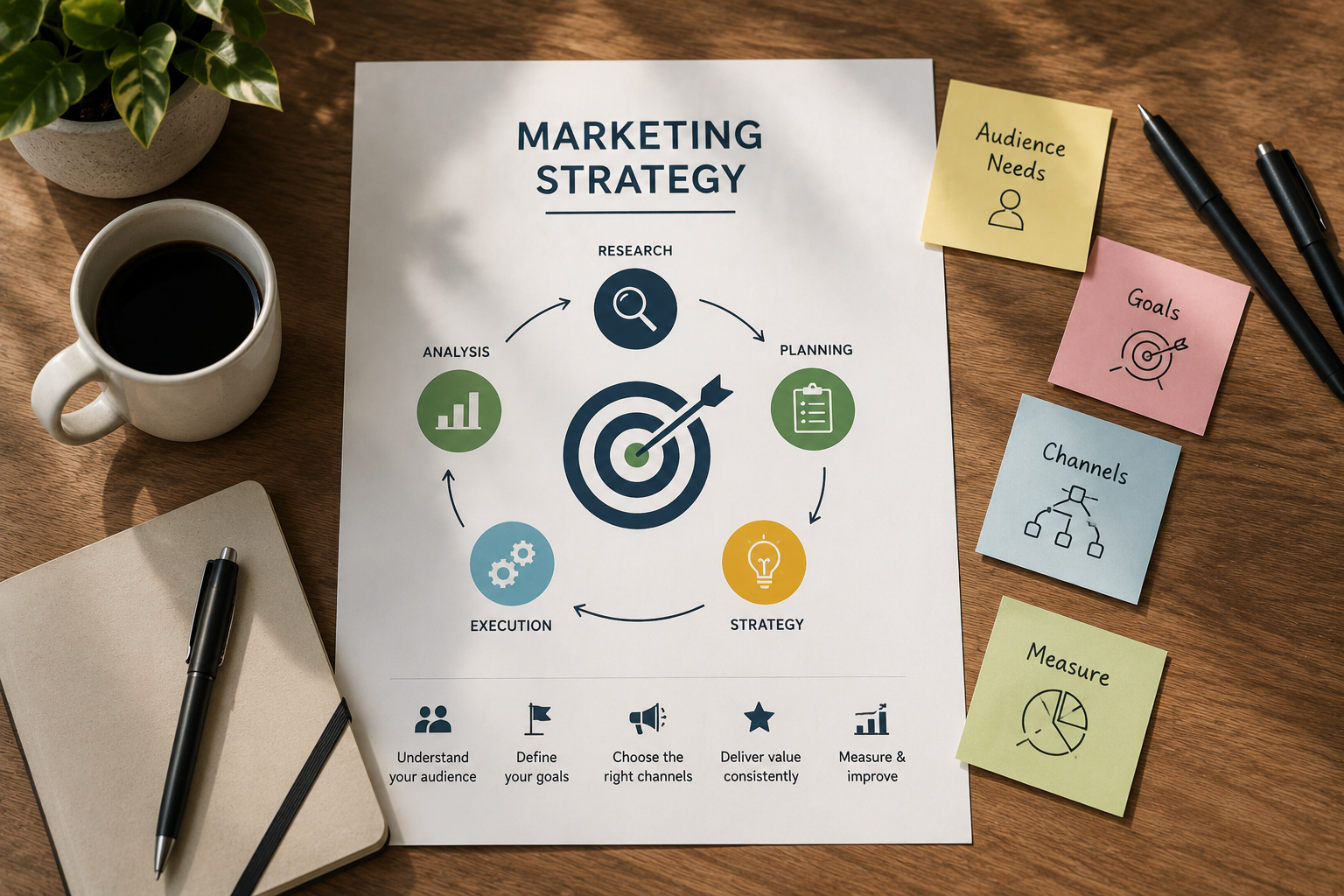
Marketing can get busy very quickly. A company launches social campaigns, publishes blog posts, runs paid ads, sends emails, updates its website, and tries the latest channel everyone is talking about. But being active does not necessarily mean the business is moving in the right direction.
That is where marketing strategy comes in.
The purpose of a marketing strategy is to give a business a clear direction for reaching the right audience, communicating its value, choosing the right marketing channels, and turning marketing activity into measurable business results.
Instead of asking, “What should we post this week?” or “Should we start running ads?”, a strategy starts with bigger questions: Who are we trying to reach? What do they need? Why should they choose us? What are we trying to achieve? And which marketing activities are most likely to get us there?
A strong strategy connects those answers so marketing becomes a coordinated system rather than a collection of disconnected tactics.
What is a marketing strategy?
A marketing strategy is the overall approach a business uses to attract, engage, and convert its target customers.
It connects business goals with decisions about audience, positioning, messaging, channels, resources, and measurement.
A marketing strategy typically answers questions such as:
- Who are our ideal customers?
- What problems are they trying to solve?
- How is our company different from competitors?
- What should customers associate with our brand?
- Which channels are most likely to reach them?
- What actions do we want them to take?
- How will we measure whether our marketing is working?
The strategy provides the direction. Individual campaigns, content pieces, ads, landing pages, and social posts are the tactics used to execute it. This distinction matters because tactics can change frequently. The underlying strategic direction should be much more deliberate.
What is the purpose of a marketing strategy?
The main purpose of a marketing strategy is to connect marketing decisions to business goals. It gives the company a framework for deciding who to target, what to communicate, where to communicate it, and how to measure success. Without that framework, teams can spend significant time and money executing campaigns without knowing whether those campaigns support the larger business. A well-defined marketing strategy serves several important purposes.
1. Align marketing with business goals
Marketing should support what the business is actually trying to accomplish.
For one company, the priority might be generating more qualified leads. Another may need to enter a new market, increase repeat purchases, introduce a new product, improve customer retention, or build greater brand awareness.
Those goals require different marketing approaches.
For example, a business focused on immediate lead generation might prioritize search visibility, landing pages, conversion optimization, and paid campaigns. A company entering a new category may need to invest more heavily in brand positioning, education, and awareness before expecting customers to convert.
Strategy creates that connection between the business objective and the marketing activity.
Instead of doing something because competitors are doing it, the company can ask a more useful question: does this help us achieve the business goal we have actually set?
2. Identify and understand the right audience
Trying to market to everyone usually produces messaging that feels relevant to no one.
A marketing strategy forces a business to define who it actually wants to reach.
That means looking beyond basic demographics and understanding the audience's problems, priorities, motivations, buying behavior, objections, and decision-making process.
A B2B software company selling to enterprise IT leaders should communicate very differently from a consumer brand selling directly to first-time buyers. Even companies selling similar products may need completely different messaging depending on the audience they want to attract.
Audience understanding influences almost every other marketing decision, including messaging, content topics, website structure, brand positioning, advertising, search strategy, social platforms, offers, and calls to action.
The better a company understands the people it wants to reach, the easier it becomes to create marketing that feels relevant rather than generic.
3. Define a clear position in the market
Customers rarely evaluate a business in isolation. They compare it with competitors, alternatives, and sometimes the option of doing nothing at all.
A marketing strategy helps define where the company fits in that landscape.
This includes identifying what makes the business different, which customer problems it solves particularly well, what value it provides, why customers should believe its claims, and how it should be perceived compared with competitors.
That positioning becomes the foundation for the company's messaging.
A strong brand strategy and marketing strategy should reinforce each other. Professional branding services determine how the business presents itself and what it wants to stand for, while marketing strategy determines how that position reaches and influences the market.
Without clear positioning, companies often default to broad claims such as "high quality," "great service," or "innovative solutions." Those statements may be true, but they rarely give customers a compelling reason to choose one business over another.
4. Create consistent messaging across channels
Customers do not experience a company through one marketing channel.
Someone may discover the brand through Google, visit the website, see a LinkedIn post several days later, receive an email, read a case study, and finally contact the sales team.
Those interactions should feel like they came from the same company.
A marketing strategy establishes the core messages that should remain consistent across the website, search campaigns, social media, email marketing, paid advertising, sales materials, case studies, landing pages, and thought leadership.
Consistency does not mean copying the same sentence everywhere. Each channel has a different format and purpose. The message can adapt while the underlying positioning remains recognizable.
For example, a LinkedIn post may be conversational while a service page is more detailed and conversion-focused. Both should still communicate the same fundamental value proposition.
5. Prioritize channels and resources
Businesses have more marketing channels available than they can realistically manage well.
SEO, paid search, social media, email, partnerships, events, content marketing, video, influencer campaigns, display advertising, webinars, and dozens of other options can all work. That does not mean every company needs all of them.
A marketing strategy helps determine which channels deserve attention based on where the target audience spends time, how customers research purchases, how long the buying cycle is, how much budget is available, what type of content the business can realistically produce, and what the business is trying to accomplish.
A high-value B2B company might generate better results from SEO, case studies, LinkedIn, and account-based campaigns than from posting several times a day across every social network.
An eCommerce brand might place much more emphasis on paid social, search, email automation, creator partnerships, and conversion optimization.
Strategy also helps a team decide what not to do. A company that understands its priorities can say no to attractive distractions that do not support the larger objective. That saved time and budget can then go toward the activities most closely tied to the goal.
6. Create measurable marketing goals
A marketing strategy should define what success looks like before campaigns begin.
Otherwise, almost any activity can be presented as a win. A social campaign generated impressions. A blog attracted traffic. An ad received clicks. Those numbers can be useful, but they only matter when they connect to the objective behind the campaign.
Depending on the strategy, useful marketing metrics might include qualified leads, conversion rate, customer acquisition cost, revenue generated, pipeline value, organic search traffic, search visibility, email sign-ups, customer retention, repeat purchases, brand awareness, or engagement from target accounts.
The right metric depends on the goal. For example, if the purpose of a campaign is to generate qualified sales opportunities, page views alone tell you very little about whether it worked.
A marketing strategy establishes that measurement framework before the team starts optimizing tactics.
7. Build a framework for testing and improvement
A marketing strategy should provide direction without becoming rigid.
Markets change. Competitors change. Customer behavior changes. New channels appear, and existing channels become less effective.
Strategy gives teams a stable framework for responding to those changes.
The goal is not to follow the original plan regardless of what the data shows. It is to understand the larger objective well enough that tactics can change without losing direction.
For example, a company may discover that paid social is generating traffic but very few qualified leads, while organic search and email are producing stronger opportunities. The strategy does not need to be abandoned. Resources can simply shift toward the channels performing best against the original objective.
That makes marketing more adaptive without making it random.
Marketing strategy vs. marketing plan: what's the difference?
Marketing strategy and marketing plan are closely related, but they are not the same thing.
A marketing strategy defines the direction. It explains who the business wants to reach, how it wants to position itself, what it wants to achieve, and the general approach it will use to get there.
A marketing plan turns that strategy into specific actions. The plan may include campaigns, content calendars, budgets, advertising schedules, channel responsibilities, deadlines, deliverables, and reporting schedules.
Think of the strategy as deciding where you are going and why. The marketing plan describes what needs to happen next to get there.
For example, a company might decide that its marketing strategy is to become the preferred web development partner for mid-market companies with complex website requirements. The marketing plan might then include publishing technical content, building industry-specific landing pages, improving case studies, investing in SEO, running targeted LinkedIn campaigns, and developing an email nurture sequence.
The individual tactics make more sense because they are connected to the same strategic objective.
What should a marketing strategy include?
There is no single template every company needs to follow, but most effective marketing strategies address several core areas.
- Business objectives - Start with what the business needs marketing to accomplish. Marketing goals should support wider priorities such as revenue growth, market expansion, lead generation, retention, or product adoption.
- Market and competitor research - Understanding the wider market helps identify opportunities, threats, customer expectations, and gaps in competitor positioning. The goal is not to copy competitors. It is to understand the environment in which customers are making decisions.
- Target audience - Define the customers the company most wants to attract. For businesses with several customer types, this may require separate audience segments with different messaging and conversion paths.
- Value proposition and positioning - Clarify what the company offers, what makes it different, and why that difference matters to the intended audience. This becomes one of the most important inputs for both marketing and website design. A website can look polished and still underperform if visitors cannot quickly understand what the company does, who it is for, and why they should care. Effective responsive web design services start with positioning clarity before touching layout or visual design.
- Messaging - Translate positioning into the ideas the company wants customers to remember. Messaging should respond to customer needs rather than simply describing the company.
- Marketing channels - Choose the channels most likely to reach the target audience and support the objective. The answer will usually be a focused combination rather than every available platform.
- Budget and resources - Determine what the company can realistically execute. A strategy that requires more content, ad spend, or technical resources than the company can support will break down during execution.
- KPIs and measurement - Define how performance will be evaluated. Good KPIs should make it easier to determine whether the strategy is contributing to actual business outcomes.
Example of a marketing strategy in practice
Consider a B2B technology company that wants to generate more qualified leads from mid-market businesses.
Without a strategy, the marketing team might simply start publishing content and running ads.
A more structured approach could look like this:
- Business goal: Increase qualified sales opportunities from mid-market companies.
- Target audience: Marketing and operations leaders responsible for selecting technology vendors.
- Positioning: A specialized technology partner capable of solving complex integration problems without the overhead of a large enterprise consultancy.
- Core message: Enterprise-level expertise with a more flexible, collaborative engagement model.
- Primary channels: SEO, thought leadership, LinkedIn, email, case studies, and targeted paid search.
- Website journey: Educational article → relevant service page → case study → consultation request.
- Primary KPIs: Qualified leads, conversion rate, pipeline value, cost per qualified opportunity, and revenue influenced by marketing.
Each tactic now has a purpose.
The company is not publishing articles simply to increase traffic. It is creating content that attracts a specific audience and moves those visitors toward a defined next step.
That is what turns individual marketing activities into a strategy.
How do you know if your marketing strategy is working?
Start with the business goal.
If the strategy was designed to generate qualified leads, evaluate whether qualified lead volume, conversion rates, pipeline, and acquisition costs are moving in the right direction.
If the goal was brand awareness, metrics such as branded search demand, direct traffic, reach within the target market, and share of voice may be more useful.
The important part is not to judge every marketing channel using the same metric.
SEO may influence customers months before a purchase. Email may help nurture existing demand. Paid search may capture buyers who are already close to making a decision.
Look at the customer journey as a whole.
A strong strategy backed by full-service digital marketing services makes it possible to understand how channels work together rather than treating every campaign as an isolated activity.
Regular reviews can then answer questions such as:
- Which channels are producing qualified opportunities?
- Which messages are resonating?
- Where are prospects dropping out?
- Which content contributes to conversions?
- Where is budget being wasted?
- Have customer priorities changed?
- Are competitors changing how they position themselves?
- Do our original assumptions still hold?
The answers should inform what happens next.
Marketing strategy gives marketing a direction
The purpose of a marketing strategy is not to create another document that sits unused in a shared folder.
It is to make marketing decisions easier and more intentional.
A strong strategy connects business goals with the audience, positioning, messaging, channels, resources, and measurements required to achieve them.
It tells a company not only what it should do, but why it should do it.
That clarity matters because successful marketing rarely comes from doing more of everything. It comes from understanding which activities deserve attention, connecting them to the same objective, and improving them over time.
When those pieces work together, marketing stops being a collection of campaigns and becomes part of how the business grows.